
Bruxism alarm using EMG
This video shows a prototype of a system that provides an audible alarm when the user suffers a case of bruxism (https://en.wikipedia.org/wiki/Bruxism). When the amplitude of the EMG signal generated by the masseter muscle (one of the muscles of mastication) exceeds a threshold set during system calibration, a buzzer emits an audible signal that wakes up the user in the case of sleep bruxism, or warns him in case of awake bruxism.
#include <MsTimer2.h>
static const unsigned int EMG_CH1 = 0;
static const unsigned int buzzerPin = 9;
static const unsigned int ledPin = 13;
static const unsigned int sampleTime = 1;
static const double adcRef= 5.00;
static const unsigned int adcRes = 1023;
static const double adcConv = adcRef/adcRes;
volatile unsigned int emg = 0;
double emgMean = 0.00;
double emgMovav = 0.00;
double emgMvc = 0.00;
volatile unsigned int sOK = 0;
unsigned int i = 0, k = 0;
/* sampling reads the ADC every 1 ms with the MsTimer2 interrupt. */
void sampling()
{
emg = analogRead(EMG_CH1);
sOK = 1; // sOK indicates that there is a new sample
}
/* meanCalc computes the mean value of the EMG signal during a period of
meanSamples. The mean value of the signal is its baseline. This value is
subtracted from the measured EMG signals to have a baseline of 0 V. */
void meanCalc(unsigned int meanSamples)
{
while(i < meanSamples)
{
delayMicroseconds(50);
if(sOK==1)
{
sOK = 0;
i++;
emgMean = emgMean + emg*adcConv;
}
}
i = 0;
emgMean = emgMean/meanSamples;
}
/* movAv computes the running moving average of the EMG signal. First, the
baseline of the signal is lowered to 0 V, to be able to rectify it. The running
moving average rectifies and smooths the signal (acts as a low pass filter),
returning the amplitude of the signal. */
void movAv()
{
double emgZero = emg*adcConv - emgMean; // Signal with 0 V baseline
emgMovav = emgMovav*0.99 + abs(emgZero)*0.01; // Rectified and smoothed signal
}
/* mvcCalc computes the maximum voluntary contraction, the maximum force the
user is able to exert. This value is used to compute the activation threshold */
void mvcCalc(unsigned int mvcSamples)
{
while(i < mvcSamples)
{
delayMicroseconds(50);
if(sOK==1)
{
sOK = 0;
i++;
movAv();
if(emgMovav > emgMvc) {
emgMvc = emgMovav;
}
}
}
i = 0;
emgMovav = 0.00;
}
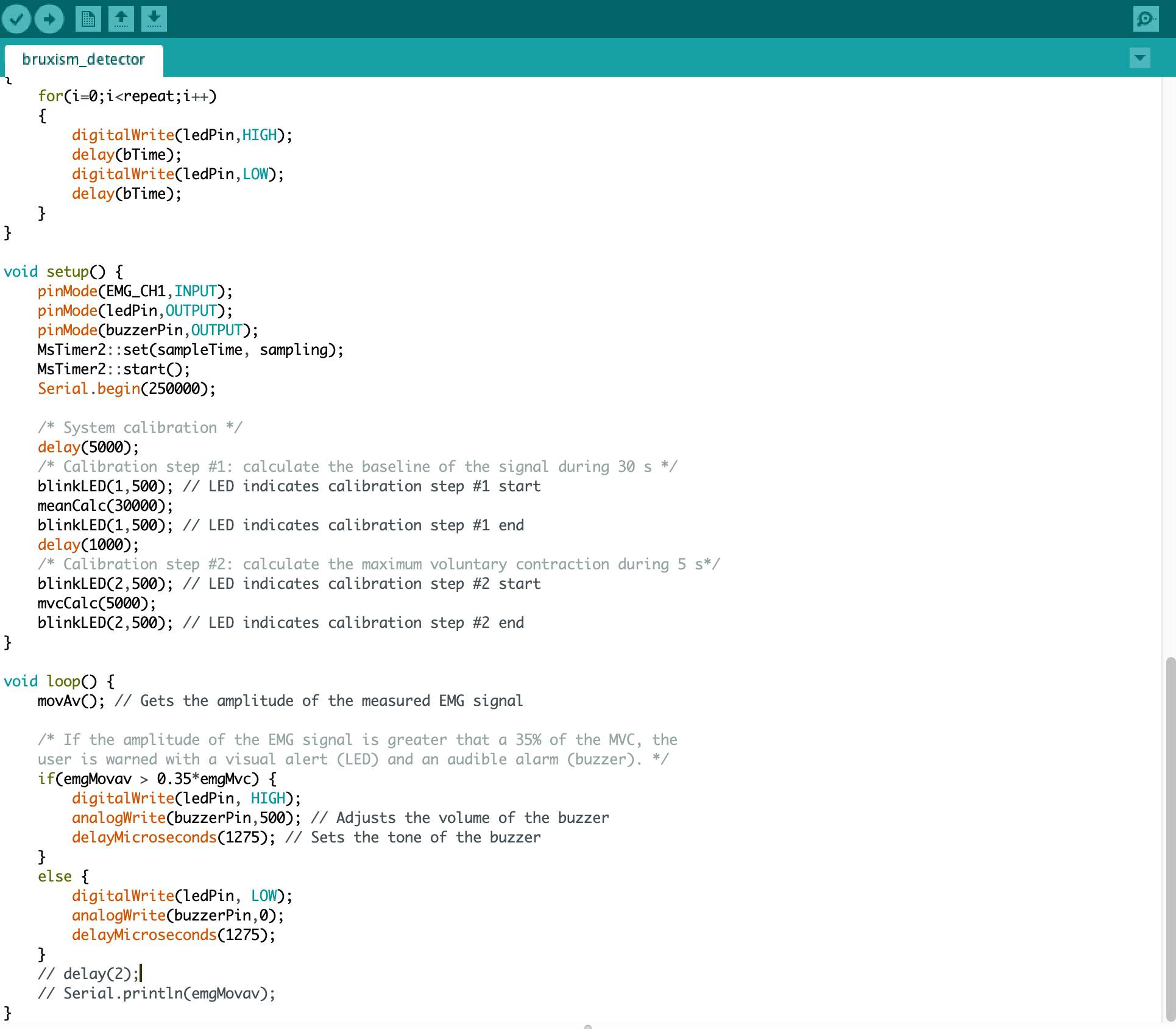
/* blinkLED blinks a led "repeat" times with a "bTime" interval between on and off */
void blinkLED(unsigned int repeat,unsigned int bTime)
{
for(i=0;i<repeat;i++)
{
digitalWrite(ledPin,HIGH);
delay(bTime);
digitalWrite(ledPin,LOW);
delay(bTime);
}
}
void setup() {
pinMode(EMG_CH1,INPUT);
pinMode(ledPin,OUTPUT);
pinMode(buzzerPin,OUTPUT);
MsTimer2::set(sampleTime, sampling);
MsTimer2::start();
Serial.begin(250000);
/* System calibration */
delay(5000);
/* Calibration step #1: calculate the baseline of the signal during 30 s */
blinkLED(1,500); // LED indicates calibration step #1 start
meanCalc(30000);
blinkLED(1,500); // LED indicates calibration step #1 end
delay(1000);
/* Calibration step #2: calculate the maximum voluntary contraction during 5 s*/
blinkLED(2,500); // LED indicates calibration step #2 start
mvcCalc(5000);
blinkLED(2,500); // LED indicates calibration step #2 end
}
void loop() {
movAv(); // Gets the amplitude of the measured EMG signal
/* If the amplitude of the EMG signal is greater that a 35% of the MVC, the
user is warned with a visual alert (LED) and an audible alarm (buzzer). */
if(emgMovav > 0.35*emgMvc) {
digitalWrite(ledPin, HIGH);
analogWrite(buzzerPin,500); // Adjusts the volume of the buzzer
delayMicroseconds(1275); // Sets the tone of the buzzer
}
else {
digitalWrite(ledPin, LOW);
analogWrite(buzzerPin,0);
delayMicroseconds(1275);
}
// delay(2);
// Serial.println(emgMovav);
}